Subadditive measures on N and the
convergence of series with positive terms
T. Šalát – T. Visnyai
In this my talk
we shall study the convergence of series with positive terms in connection with
a submeasure on 
 and full classes


 . The starting – point of our consideration is the following
observation of the work Estrada – Kanwal, [3] : let
. The starting – point of our consideration is the following
observation of the work Estrada – Kanwal, [3] : let  be a series with positive terms. If for each
  with
with  we have
  , then
  . This result is formulated in a stronger form in the work
[6]. There it is shown, that in last result the function d can be replaced by
the function u (uniform density). Consequently, if series with positive terms
convergences for each
. This result is formulated in a stronger form in the work
[6]. There it is shown, that in last result the function d can be replaced by
the function u (uniform density). Consequently, if series with positive terms
convergences for each  where A is set of
null uniform density then it convergences on N. In the proof of this assertion we use the fact that uniform
density of a set
where A is set of
null uniform density then it convergences on N. In the proof of this assertion we use the fact that uniform
density of a set  is a compact
submeasure. We also show that the upper Alexanders density is a compact
submeasure and the class of all sets
is a compact
submeasure. We also show that the upper Alexanders density is a compact
submeasure and the class of all sets  with
with  is a full class.
We recall the concept of asymptotic, uniform and upper Alexanders densities, further the concept of submeasures and full classes.
Let  . Denote by
  ,
, the number of elements of the set
 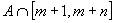 . Then the numbers
 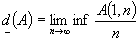 and
and 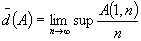 are called the lower
and upper asymptotic density of the set
are called the lower
and upper asymptotic density of the set  , respectively. If
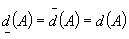 , then
  is said to be the
asymptotic density of the set
is said to be the
asymptotic density of the set  .
Further we put
.
Further we put  . It can be shown that there exist
 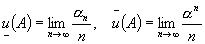 (the lower and upper
uniform density of the set
(the lower and upper
uniform density of the set  , cf. [1] ). It can
be easily seen that
, cf. [1] ). It can
be easily seen that

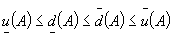 .
.
We
recall the concept of a submeasure on 
 . A function m :

 is said to be a
compact submeasure on
is said to be a
compact submeasure on 
 provided that
  satisfies the following
four conditions:
satisfies the following
four conditions:



 , (cf. [5]).
 for each
  we have
 for each
  there exists a
decomposition
there exists a
decomposition  of
of  such that
 for each
  .
.
Theorem A. Paštéka 1990.
Let  be a compact
submeasure on
be a compact
submeasure on
 and
and  a series with positive terms.
If for each  with
with  we have
  , then
  .
.
The
upper asymptotic density  is a compact
submeasure on
is a compact
submeasure on 
 . Therefore as a consequence of Theorem A we obtain the
following result.
. Therefore as a consequence of Theorem A we obtain the
following result.
Theorem B. Estrada – Kanwal 1986.
Let  be a series with positive terms.
If for each  with
with  we have
  , then
  .
.
Main results
The
natural question arises whether the function  can be replaced in Theorem B. by the function
  . The following theorem give positive answer to this
question.
. The following theorem give positive answer to this
question.
Theorem 1.
Let  be a series with positive terms.
If for each  with
with  we have
  , then
  .
.
Proof.
It can be easily cheeked that  is a compact
submeasure. Especially if
is a compact
submeasure. Especially if  then we choose an
  such that
  . Then
 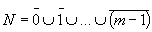 is the desired
decomposition of
is the desired
decomposition of  in the definition of
the compact submeasure.
in the definition of
the compact submeasure.
In
what follows we assume  and
and  . If
. If  , we put
 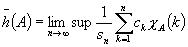 and
and 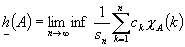 where
where  and
and  is the characteristic
function of A. The
is the characteristic
function of A. The  denotes upper, the
  lower Alexanders
density of the set
lower Alexanders
density of the set  . If
. If 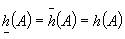 , then
  is said to be the
Alexanders density of the set
is said to be the
Alexanders density of the set  . Taking
 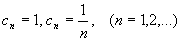 the function
  will mean upper
asymptotic density
will mean upper
asymptotic density  , the upper logarithmic density
  , respectively.
Theorem 2.
Let 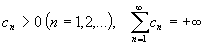 .
.
Suppose that 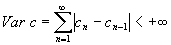 .
.
Then  is a compact
submeasure.
is a compact
submeasure.
Finally, we recall the concept of a full class. A class 


 is said to be a full class if the following conditions are
satisfied:
is said to be a full class if the following conditions are
satisfied:
1)
N 
2)
if 
 and
and  , then

3)
if  is a series with
positive terms and
is a series with
positive terms and  for each set
 , then
  .
.
A trivial example of a full class is 
 . Further the class
  of all
  with
with  is a full class (see
Theorem B.) an analogous statement holds for the class
is a full class (see
Theorem B.) an analogous statement holds for the class  of all
  with
with  (see Theorem 1.). Note that
  according to
  . It can be shown that this inclusion is strict ( Example:
put
. It can be shown that this inclusion is strict ( Example:
put 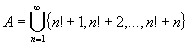 ).
).
Theorem 3.
If
sequence  have a bounded
variation,
have a bounded
variation, 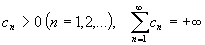 , then class
  is a full.
Rerences.
[1] Alexander,R. : Density and multiplicative structure of sets of
integers. Acta Arithm. XII. (1967), 321 – 329.
[2] Mačaj, M. – Mišík, L. – Šalát, T. – Tomanová, J.: On class of densities of sets of positive
integers. AMUC LXXII. (2003), 213 – 221.
[3] Estrada, R. – Kanwal, R.P.: Series that converge on sets of null
density, Proc. Amer. Math.
Soc. 97 (1986), 682 – 686.
[4] Paštéka, M.: Convergence of series and submeasures of the set of positive
integers,
Math. Slov. 40 (1990), 273 – 278.
[5] Sember, J.J.- Freedman, A. R.: On summing sequences of 0’s and 1’s, Rockey Mountain
J. Math. 11 (1981), 419 – 425.
[6] Šalát, T. – Visnyai, T.: Subadditive measures on N and the convergence of series with
positive terms, Acta Mathematica 6 (2003), 43 – 52.